ScorecardsResults and publishingConcept
A legislator's arithmetic
The voting record panel line by line, with a worked example of how one legislator's score is computed.
Select any legislator on a scorecard and their score opens in a panel: who they are and how to reach them, their score and grade, and Voting record on scorecard bills — every bill on the scorecard, what they did on it, and what that did to the score. It shows the denominator rather than asserting it, so anyone can check a score with a pencil.
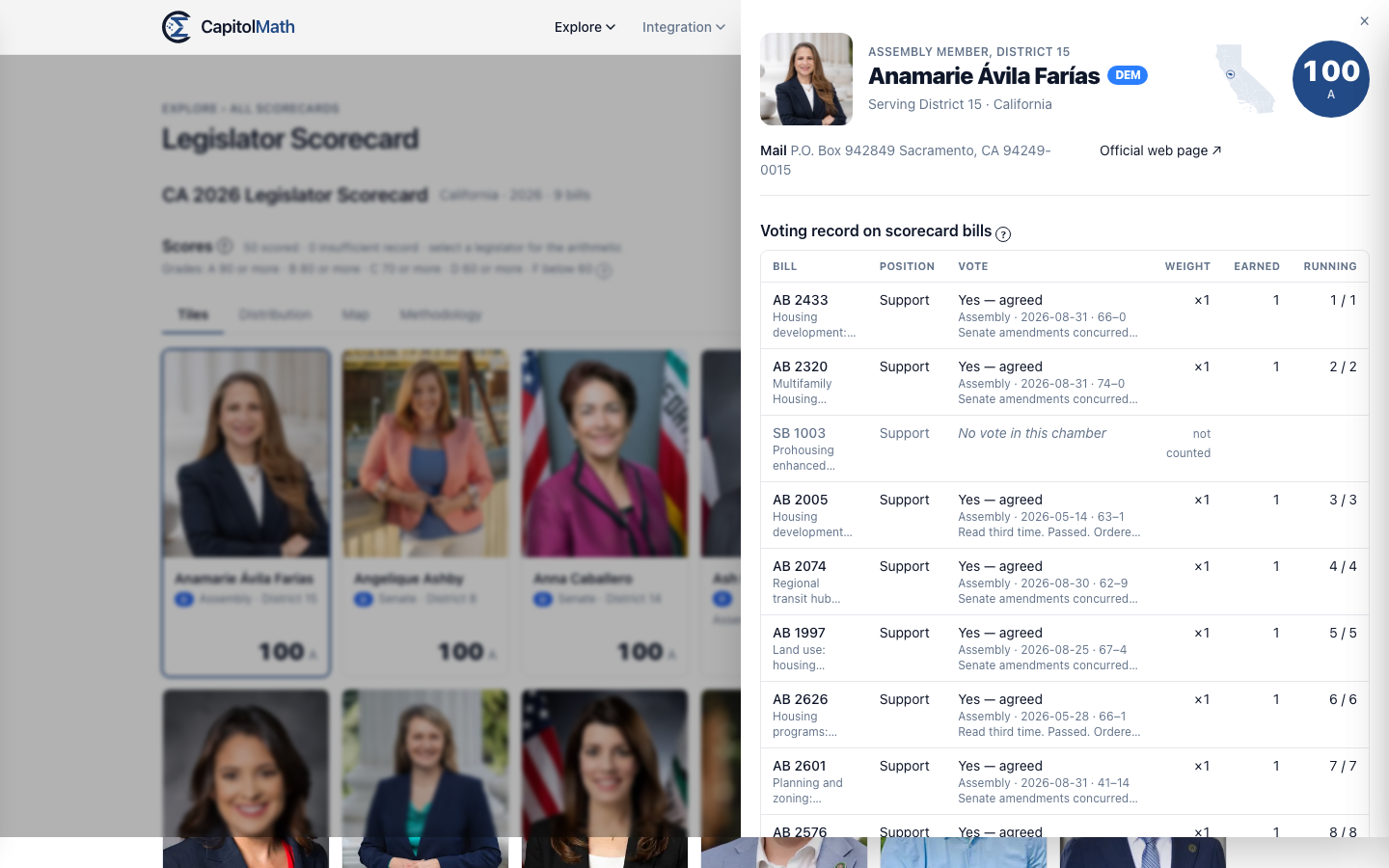
The panel, line by line#
The header shows the legislator's office and district, their party, their score and grade in a circle, and the phone number, mailing address and web pages on record. Below it, the voting record has a row per bill, in the scorecard's order:
| Column | Shows |
|---|---|
| Bill | The bill's number and title. Select it to read the bill. |
| Position | Your organization's position — Support or Oppose — and its public rationale. |
| Vote | What the legislator did and what the scorecard made of it, with the roll call it came from: chamber, date, yes–no count and motion. |
| Weight | The bill's weight, such as ×3, or not counted. |
| Earned | The weight times the credit: the full weight for agreeing, none for disagreeing, and for a missing vote whatever the rule gives. |
| Running | Weight earned so far / weight possible so far. |
A bill that's left out is grayed, with the reason in the Vote column: No vote in this chamber, Not seated at the time, Not recorded in the roll call, or, under Leave out, a missing vote "left out under the non-vote rule". It adds nothing to either side of the division.
The last line divides: Score = weight earned ÷ weight possible. The score is that fraction as a percentage, rounded to one decimal place.
The same record opens from a scorecard widget on your website when the widget is set to Open details inside the widget; see Opening details inside a widget.
A worked example#
A California scorecard scores six bills, with Count against for missing votes and a minimum of 5. This is the panel for a member of the Assembly:
| Bill | Position | Vote | Weight | Earned | Running |
|---|---|---|---|---|---|
| AB 1001 | Support | Yes — agreed | ×3 | 3 | 3 / 3 |
| AB 1002 | Oppose | Yes — disagreed | ×2 | 0 | 3 / 5 |
| AB 1003 | Support | No vote recorded — counted against | ×1 | 0 | 3 / 6 |
| AB 1004 | Support | Yes — agreed | ×1 | 1 | 4 / 7 |
| SB 2005 | Support | No vote in this chamber | not counted | ||
| AB 1006 | Oppose | No — agreed | ×1.5 | 1.5 | 5.5 / 8.5 |
SB 2005, a key vote, passed the Senate but never came to a floor vote in the Assembly, so this member had no chance to vote on it and it's left out. That leaves five bills counted, which meets the minimum of 5.
Score = 5.5 ÷ 8.5 = 64.7, a D.
The same record under the other two rules:
- Half credit: AB 1003 earns 0.5, so the score is 6 ÷ 8.5 = 70.6, a C.
- Leave out: AB 1003 is left out too, so only four bills count. That's below the minimum of 5, so the member shows Insufficient record — scored on 4 of the 5 bills needed and has no score or grade.
One missing vote moves this member from a C to a D to no score at all, which is why the Rules step shows every member under each rule before you choose.
A member who changed chamber#
Each bill counts once. For each bill, the scorecard uses the latest counted roll call in a chamber the member sat in when it was taken, so a member who moved from one chamber to the other is judged in the chamber they were in for each vote.