ScorecardsBuilding a scorecardConcept
Rules: missing votes and the minimum
How a scorecard treats a member who didn't vote, what is never counted, and when a member has too few bills for a score.
The Rules step settles the two questions the arithmetic can't answer on its own: what to do when a member was there but didn't vote, and how few scored bills are too few for a fair score. Everything else about who counts on which bill is fixed, so that no setting can mark someone down for a vote they had no chance to cast.
What is never counted#
A bill is left out of a member's score entirely, from both the weight earned and the weight possible, when:
- Their chamber never voted on it. The bill had no scored roll call in any chamber the member sat in.
- They weren't seated at the time. A member counts as seated in a chamber from their first to their last recorded vote there that session, so someone who joined or left mid-session isn't judged on votes outside that span.
- The roll call doesn't record them at all. Some chambers leave absent members out of a roll call, and a name the record couldn't match looks the same. Neither is a choice the member made. The coverage gate keeps this rare.
These aren't settings. They're applied the same way on every scorecard.
Missing votes#
A roll call can record that a member didn't vote, but not yet why: an excused absence and a deliberate abstention look the same in the record. So one rule covers both, and you choose it:
| Rule |
|---|
| Leave out |
| Count against |
| Half credit |
What each does to a bill the member didn't vote on:
| Rule | Weight possible | Weight earned |
|---|---|---|
| Leave out | The bill is left out, as if it hadn't come up | Nothing |
| Count against | The bill's full weight | Nothing — the same as a vote against your position |
| Half credit | The bill's full weight | Half the bill's weight |
A new scorecard starts with Count against. Half credit is offered, but it's hard to explain on a public page, and the Review step says so.
Whichever you choose, the scorecard states it in a sentence under With the scores, on its Methodology tab and in any widget. For example: "Recorded non-votes count as a vote against our position."
Comparing the rules#
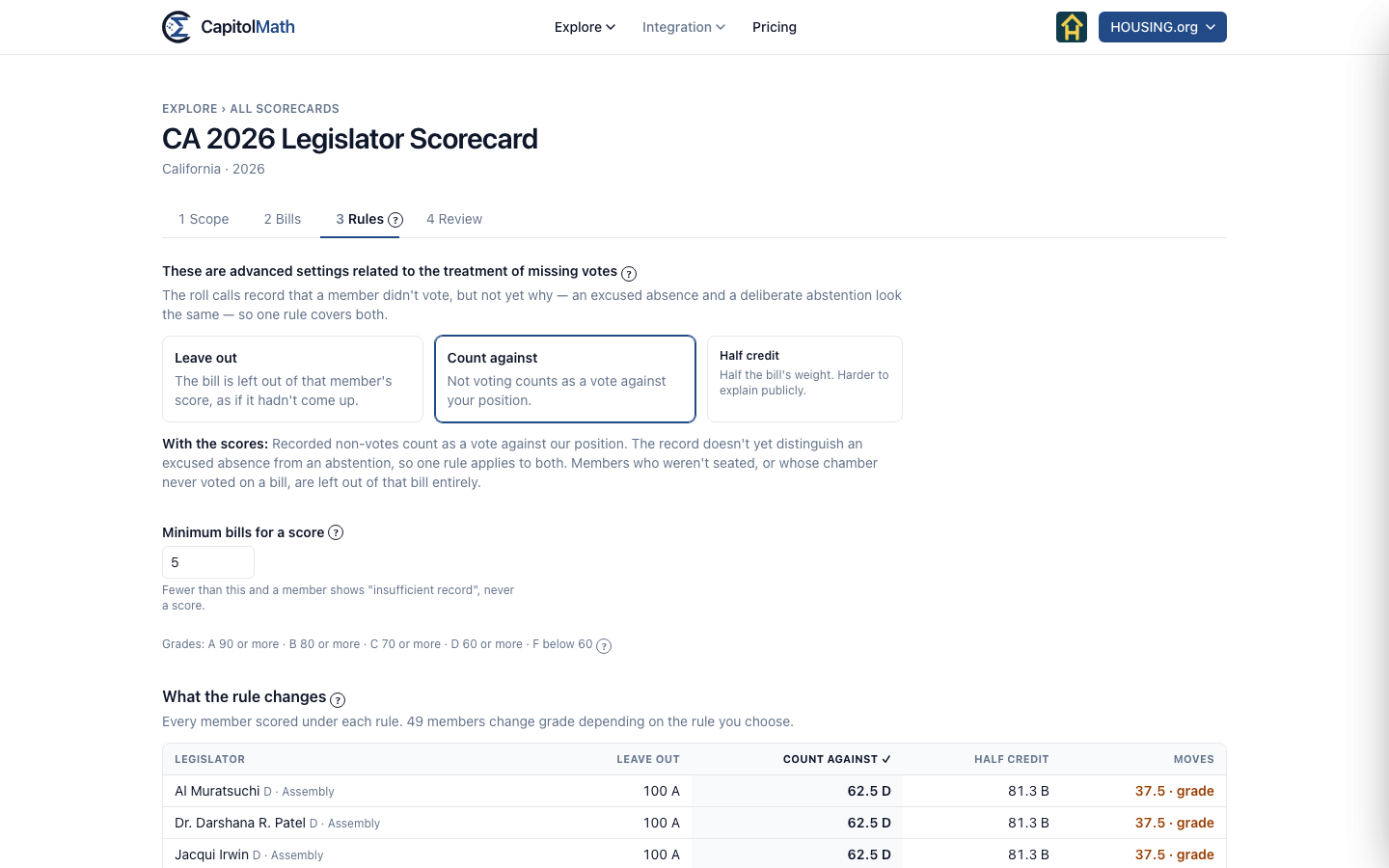
The rule you choose can change grades, so the Rules step shows the consequence before you commit. What the rule changes scores every member under all three rules, side by side, with your current choice marked ✓. Members whose grade depends on the rule are listed first, and Moves shows how far their score swings. The first 25 members show; Show all shows the rest.
The minimum#
Minimum bills for a score is how many bills a member must be scorable on before they get a number. It starts at 5 and can be any whole number from 1 to 50.
A member below it shows insufficient record and the count — "4 of 5 bills" — never a score or a grade. A member seated late in the session, eligible for three bills, hasn't earned a low score; their record is too thin to measure. They're listed after the scored members, never hidden, and the Review step says how many there are.
Under Leave out, a missing vote also drops that bill from the member's count, so the rule and the minimum work together: see the worked example in A legislator's arithmetic.